
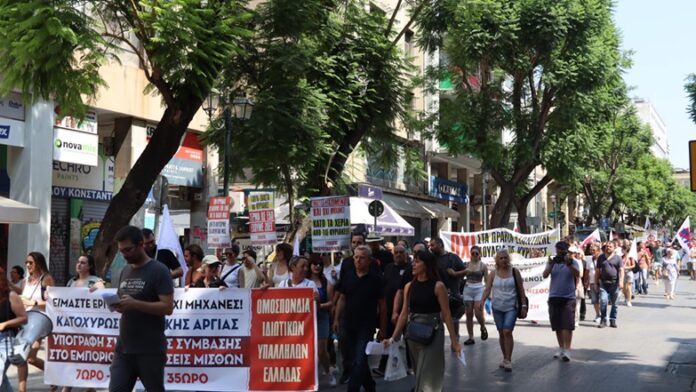
Thousands of commerce workers across Greece sent a strong and militant strike message on Sunday, 19 July 2026, demanding the protection of Sunday as a day of rest and the signing of a sectoral Collective Bargaining Agreement.
The nationwide strike, called by the Federation of Private Employees of Greece, was marked by strike rallies, demonstrations, and interventions outside shops, supermarkets, and shopping centres.
Mobilisations took place in 18 cities throughout the country, from Athens and Thessaloniki to Crete, Epirus, Thessaly, Central Greece, Evros and the Greek islands. Commerce workers made it clear that they will not accept the transformation of Sunday into yet another working day.
Dozens of sectoral trade unions participated in the strike, alongside workplace unions representing employees at major companies, including IKEA and Lidl amongst others.
With banners, slogans, and organised strike action, workers highlighted the harsh conditions prevailing throughout the sector, wages that have remained frozen while the cost of living continues to rise, work intensification, widespread part-time employment, split shifts, constantly changing schedules, and Sunday work that deprives thousands of workers of their free time, family life, and the ability to plan their lives.
“We are workers, not machines. Sundays belong to workers and their families, not to the large retail corporations,” was the message heard loudly during the strike mobilisations.
These conditions are not accidental. They are the result of policies consistently implemented by successive liberal and social-democratic governments, which have dismantled working-time protections, expanded flexible employment, facilitated Sunday trading, and kept wages at extremely low levels.
Despite their differences in name and political rhetoric, these governments have followed the same strategic direction, serving the profitability and competitiveness of major business groups and multinational corporations.
European Union policies have promoted the liberalisation of working hours, labour-market flexibility, and the weakening of collective bargaining rights. Commerce workers are being asked to work longer, harder, and under increasingly unstable conditions so that multinational retail chains, supermarket groups, and large employers can increase their profits.
The strike placed at the centre of the struggle the demand for a sectoral Collective Bargaining Agreement providing substantial wage increases, the legal protection of Sunday as a day of rest, stable daily and weekly working hours, the abolition of split shifts, and effective health and safety measures in every workplace.
Workers and trade unions sent a mass and determined message that the strike of 19 July was not an isolated mobilisation, but an important step in the continuation and escalation of the struggle.
The effort will continue inside shops, supermarkets, shopping centres and warehouses, with the aim of organising more workers in the unions, strengthening collective action and developing new militant initiatives against employers and government policies.
The next major point of mobilisation will be the nationwide mass rally on 5 September in Thessaloniki, during the Thessaloniki International Fair. Commerce workers will join their voices with workers from other sectors, the self-employed, farmers, pensioners, and young people.
No sacrifice for the profits and wars of the EU – NATO – US!
Money for wages, healthcare, and education!
See photos and videos at the links below:
PHOTOS
Photos from the strike mobilisation:
https://flic.kr/s/aHBqjCZx7j
VIDEO
Strike mobilisation by commerce workers: