
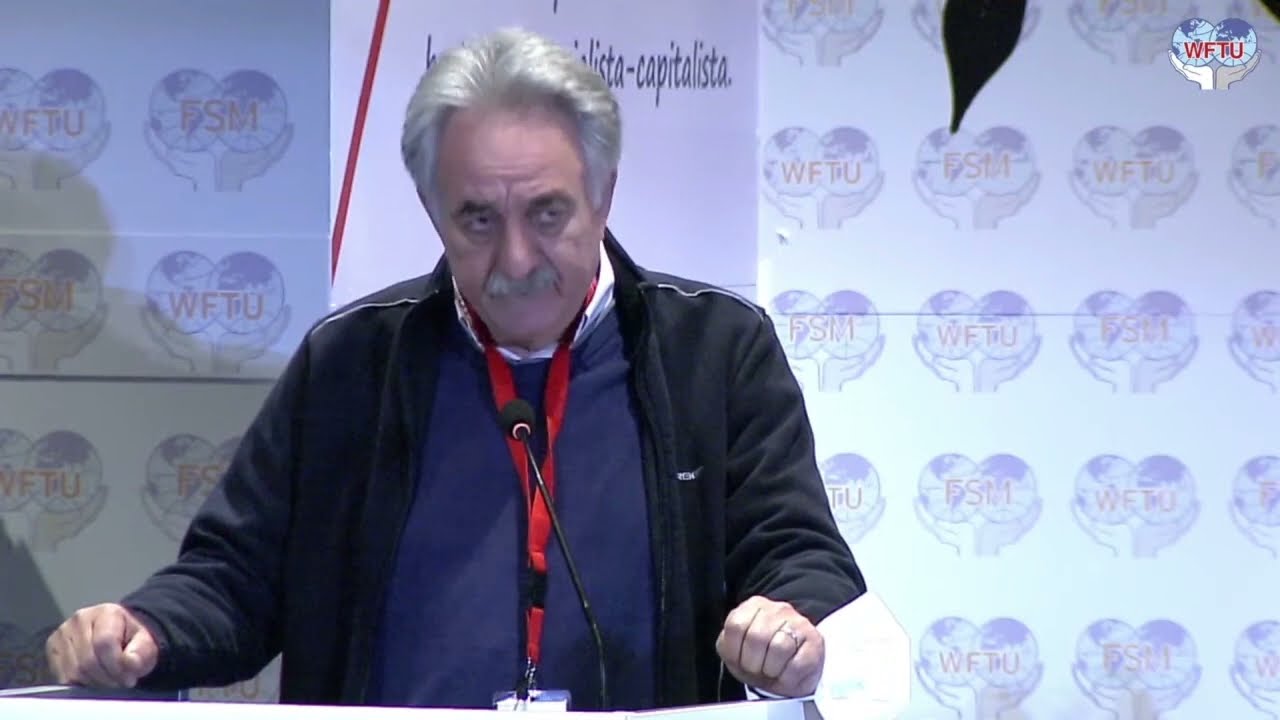
Speech by Giorgos Perros at the Presidential Council of the WFTU, 12–13 May 2026
Dear comrades,
On behalf of PAME, we greet the work of the Presidential Council of the WFTU, all its cadres, and the trade unions that have led militant mobilizations in every country.
Such an important meeting should have taken place in person. Direct contact, collective discussion, the exchange of experience, and live debate are irreplaceable for the international class-oriented movement.
Discussing over the internet does not help the class-oriented movement or our organizations. In the Presidential Council meetings, we discuss how to correct weaknesses, we exercise criticism and self-criticism, and we set out a plan.
We are meeting at a time when the global capitalist economy is heading toward a new crisis and entering a phase of intense instability, accelerated by the surge in energy prices due to the closure of the Strait of Hormuz.
The peoples are paying with their blood for the profits of the exploiters. The gangster invasion of Iran by the USA and Israel, the genocide of the Palestinian people by the murderous state of Israel, with the support of the USA, NATO, and the EU, the war in Ukraine and in the Middle East.
Part of the same chain is the imperialist aggression of the USA in Latin America, the criminal blockade of Cuba, aimed at overthrowing the Revolution, and the military intervention in Venezuela with the kidnapping of the President, a development that most likely could not have taken place without the support of the country’s social-democratic leadership.
The confrontation between the USA and China for supremacy in the imperialist system runs through all developments. It is not a conflict between “progressive” and “reactionary” centers. It is a rivalry between major capitalist states and monopoly groups over markets, energy sources, transport routes, raw materials, and spheres of influence.
The working class has no interest in aligning itself behind any camp of exploiters. Aggression is not the exclusive privilege of US imperialism. We see this in the military conflict between the EU–NATO and Russia in Ukraine, or in China’s policy, which disputes the sovereign rights of Vietnam, the Philippines, Malaysia, Brunei, and Indonesia. Rivalries are also expressed within NATO itself, between the USA and the EU. The dilemma “Euro-Atlantic or Eurasian camp” is a false one and undermines the independent ideological and political struggle of the working class.
Humanity stands, more than at any other time in recent decades, on the brink of a generalized military conflict, with the danger of a third world war becoming increasingly visible. This comes 81 years after the crushing of Nazism by the Red Army, 81 years after the great Anti-Fascist Victory of May 9.
The war economy is becoming the pretext for a new attack on workers’ rights. Governments are giving big capital billions for armaments, bases, and war infrastructure, while workers face high prices, low wages, 13-hour working days, flexible work, the dismantling of collective agreements, privatizations, the commercialization of health and education, and the repression of trade union activity.
At the core of the EU’s strategy are competitiveness and profits. This is not a deviation; it is its very character as a union of capital. Neoliberal and social-democratic versions of government serve the same path against the peoples. The answer is not a “different management” of the EU, but a clash with the policy and power of capital.
For the class-oriented trade union movement, the issue is not simply to formulate correct general positions. We are all judged by how many workers we bring into the struggle. It is a deeply political question; what kind of movement can lead organized disobedience, cultivate fearlessness and courage among workers to fight for a life without exploitation, target the real causes of wars, and put forward the way out through organized struggle.
From this standpoint, the strike and International Day of Action of dockworkers on February 6 is valuable experience for the whole WFTU. Under the slogan “Dockworkers do not work for war,” workers in 20 ports, in 7 countries, coordinated their action against the transport of war material, the militarization of ports, the slaughter of the Palestinian people, and the war economy.
It was the result of preparation, meetings, common elaboration of a framework, coordination among unions, decisions inside the workplaces, and an effort to turn internationalist solidarity into a strike response at the points where the interests of capital and war plans pass through.
This experience can become a method of work for the TUIs. Organized, common action; connecting the demand for collective agreements, wage increases, health and safety, stable jobs, and reduced working time with the struggle against imperialist war.
TUIs must not limit themselves to anniversary initiatives or general campaigns. Without underestimating anything, seminars, interventions in international organizations, and global days of action alone are not enough. They must plan steady, sectoral international coordination, with meetings, common days of action, strike initiatives, and interventions in workplaces. They must shape demands that are rooted in real needs and, at the same time, clash with the goals of the war economy, in confrontation with capital and governments of every shade, social-democratic or neoliberal.
Every sector has its own “ports,” the critical points where it can stop the war plans of the exploiters. In transport, war material must be blocked. In energy, the connection between energy rivalries, high prices, and war must be exposed. In telecommunications and technology, the role of digital infrastructure in surveillance, repression, and the military machine must be highlighted.
If we want the WFTU to become more effective, TUIs must acquire more stable functioning and better links with unions in every country. This is a weakness that we must face courageously. I will make my own self-criticism regarding TUIs. I did not give as much help as was necessary; I did not try hard enough to help them function better and in a more organized way, or to take initiatives of coordination. But I would also like to see more cooperation and concern from the heads of TUIs, so that our task can be made easier.
Strengthening our TUIs is a condition for the ideological and political confrontation with the ITUC, in order to isolate its line. It is a class duty and must be a permanent concern of the Secretariat. We must strike against employer-led and government-controlled trade unionism, which, in the name of “national interest,” “competitiveness and profitability,” and the “war economy,” calls on workers to accept the goals of governments, monopolies, NATO, and the EU.
The recent nationwide meeting of PAME confirms that the decisive factor is work from below. More than 720 trade union organizations and 2,000 trade unionists from all over Greece participated. It was the largest trade union meeting ever held. Its success was the result of persistent work in enterprises and sectors, against capital and governments, and in confrontation with employer-led and government-controlled trade unionism. This work is also reflected in the shift in the balance of forces in favor of the class-oriented forces in major unions: in the Athens Regional Union, in the Confederation of Civil Servants (ADEDY), and in the significant rise of the class-oriented forces in the Confederation of Workers of Greece (GSEE) .
It is necessary that we function more collectively, that we listen to the opinions and observations of all cadres. A general without an army, and without capable, battle-ready, ideologically prepared cadres, will not be able to carry through the decisions of the Rome Congress so that we can prepare for the 2027 Congress. Ahead of that Congress, we believe it would be useful for our members in every country to organize pre-congress procedures. The WFTU has a great responsibility and the capacity to become an effective support for struggles. We also propose that we organise a joint secretariat meeting with the the TUIs.
PAME will contribute with all its strength: with the experience of the trade unions in Greece, with its firm internationalist stance, and with its action against involvement in the imperialist wars of the USA–NATO–EU.
The PAME delegations that visited Palestine and Cuba conveyed the solidarity of the workers of Greece to the peoples targeted by imperialist aggression, blockade, interventions, and occupation. In Cuba, the trade unions from Greece delivered financial aid, while recently a major campaign of financial solidarity has been realized by the unions, the proceeds of which will be delivered to the Cuban people.
Across the country, every day, trade unions organize events, marches, and rallies against imperialist war, expressing solidarity with the peoples of Cuba, Palestine, Iran, Venezuela, Lebanon, and every people fighting for their rights.
For the working class, the only way forward is to shape the conditions for the overthrow of capitalist barbarity, for a society without exploitation of man by man and without imperialist wars.