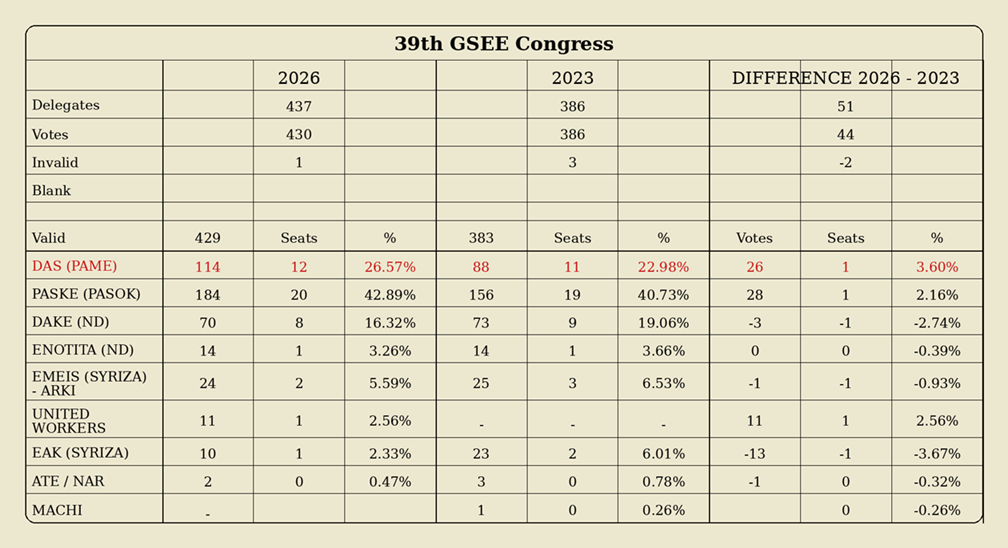


PAME trade unionists together with other vanguard militants recorded a 27% of the delegates vote at the ballot of the 39th Congress of the General Confederation of Workers of Greece (GSEE) that took place on the 16th to 19th of April (see for details the relevant table with the results). It is the highest percentage of the past decades, confirming the important steps being taken in the course of regrouping the labor movement.
This positive result was also aided by trade unionists elected from other factions, who through their vote turned their backs on the blackmailing dilemmas posed by the leading group of the GSEE.
Despite the negative correlation of forces that still remains in the leadership of the GSEE, which to a great extent is the product of fraud, the rise of the class oriented forces is a continuation of the great effort being carried out by thousands of young, militant trade unionists in workplaces, by hundreds of unions that do not compromise with the logic of the lesser evil, with fatalism and passivity. They are at the forefront of the difficult course of organizing the working class in the unions, of organizing the struggle for its interests, far from the poison of social partnership and class collaboration. They are at the forefront of the effort to change the balance of forces and strengthen the current of opposition to the dominant policy, against the system of war and capitalist exploitation.
This action, with this orientation, is leading to a shift in the balance of forces in the country’s largest Regional Unions, in Athens, Thessaloniki, Piraeus, Patras, Larissa, Ioannina, and Evia, as well as in major Federations such as that of Private Employees. It is also resulting in the emergence of dozens of new trade unionists, men and women, who came to the fore through major struggles in workplaces and sectors, and in the founding of dozens of new unions.
This was the new and hopeful element that emerged at the 39th Congress of the GSEE, in contrast to the rot of employer-controlled and government trade unionism, which, as was once again confirmed, is largely based on certain organizations, for example Regional Unions, in provincial areas, which, despite having shown no activity over all these years, record a huge increase in trade union participation and in the reproduction of bogus delegates. This is the same mechanism that recently came to light in connection with the scandal over the embezzlement of European programs, for which the retired president of the GSEE is under investigation. Despite the crude anti-communist poison the president of the GSEE poured into the proceedings of the Congress, he could not cover up what was obvious to everyone in the congress hall and was reflected in the PAME trade unionists result.
The workers of our country have nothing good to expect from this life-tenured leadership of the GSEE. On the contrary, the government and big employers have promissory notes to collect, with interest, from their people, whom they installed through mechanisms now well known to everyone to pose as the leadership of the working class. But they are reckoning without the real labor trade union movement, which is regrouping itself, changing the balance of forces, and finding a common stride with the movement of the farmers, the self-employed, and the youth. A movement that is fighting important and hopeful battles against the government and the employers.
We are throwing all our strength into the success of the May 1 strike, so that all the streets of the country will be flooded with strikers, so that the hopeful message of organization, militant revival, and struggle from the great all-workers assembly in Kaisariani, of the 720 unions and 2,000 trade unionists, the largest ever held in the country, reaches every worker and every workplace.
The real balance of forces is recorded in the streets of struggle. There, the workers will once again isolate the trade union bureaucrats by flooding the unions’ strike rallies. In these rallies there is a place for all unions that are concerned and worried, that do not reconcile themselves with the rot of employer-controlled and government trade unionism. Because that is where everyone is judged: in the workplaces and the sectors, on the road of struggle. That is where ideas are tested. That is where hope is born, and that is where real overturn comes to grow stronger.